|
| |
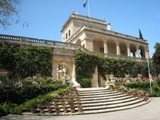
Sant'Anton is not only rich in artistic and historical legacies, but has been a historical center for entertainment and celebrations and a constant job-provider and place of apprenticeship for Attard residents. The palace has greeted numerous royalty across the centuries, including Queen Marie of Romania, the Russian Empress Marie Feodorovna, King Edward VII and Queen Elizabeth II in this century alone. It has seen the most distinguished visitors in contrasting personal situations - Napoleon's younger brother Louis Bonaparte as a prisoner, the poet Samuel Taylor Coleridge as an admiring recluse.
Governor Borton opened its botanic gardens to the public in 1882 for picnics and strolls. Its shaded open courtyards and gardens regularly host extremely popular fairs and competitions celebrating plants, flowers, pedigree (and non-pedigree) animals and livestock. A dramatic company put on a Shakespeare Festival every summer (this has since been discontinued) and music recitals, from chamber orchestras to jazz quarters, often patronize the gardens.
During the Commonwealth Heads of Government Meeting 2005, hosted by Malta, the President's Palace in Attard served as a residence for Queen Elizabeth II and Prince Philip. |
|
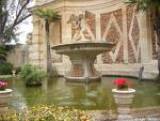
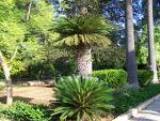
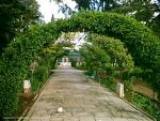
The public gardens of San Anton, open to the public since 1882, are laid out in a formal manner, with graceful walkways, sculptures, ornamental ponds, families of ducks and swans, and a small aviary. They contain a large variety of trees and flowers from around the world, including a variety of palm trees, cypress, jacarandas, araucarias and other exotic plants, some of them over three centuries old. For many years it has been customary for visiting Heads of State to plant a tree in memory of their stay in Malta. The gardens also contain an orangerie, and it was once the practice of incumbent Governors to give baskets of oranges grown in the palace gardens as gifts at Christmas time. |
|
|
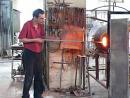
The military airstrip had been abandoned for many years when somebody started using the disused hangar as a workshop for glass-blowing. And so it came about that the Ta’ Qali Crafts Village was born.
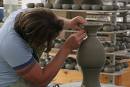
In a short time the Nissen huts there were taken over by other craftsmen and new huts built. Traditional arts like pottery, silver and gold filigree, and lace making were collected in one place soon to be joined by’other, possibly less traditional, handicrafts. |
|
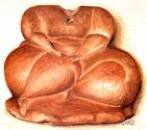
Among the light industries carried on at Ta’ Qali is the making of polished stone ornaments using Malta “marble” as raw material; the Malta Stone workshop carries a sign offering the visitor a “piece of Malta” to take back home. For those who want to take back a piece of Maltese history one can buy a replica of a knight’s suit of armour (they come in all sizes) or even a pottery copy of the Fat Lady. |
|
|
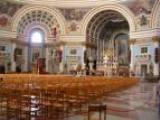
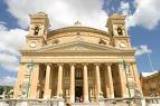
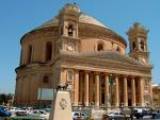
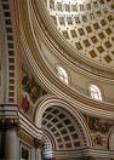
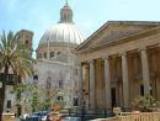
Mosta boasts the third largest unsupported dome in the World [1] dedicated to the Assumption. The Feast of the Assumption is held on August 15 and it is a public holiday. The church is also known as the Rotunda of St Marija Assunta. On 9 April 1942, the church was nearly destroyed during World War 2. An Axis bomb pierced the dome of the church but failed to explode. The detonator was removed and a replica bomb is now displayed as a memorial. |
|
The Rotunda was designed by George Grognet de Vasse, a French citizen but resident in Mosta. Mosta residents, at that time totalling not more than 1500, built this spectacular church by their own hands. It took them 27 years to complete but the result is a tourist attraction of world standard. Grognet chose the type of stone by insisting on having one slab from each quarry operating in the Islands. He then proceeded to test their durability. In the end he chose a quarry in Mosta near to Ta' Vnezja, at the gate of an old military airfield. The stone of the Rotunda bathes in the sun and spectacularly has taken a yellow/orange/red colour. |
|
|
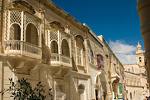
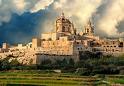
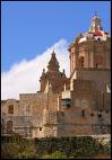
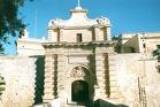
Mdina was inhabited and possibly first fortified by the Phoenicians around 700 BCE. The Phoenicians called it Maleth.[2] The region benefits from its strategic location on one of the island's highest points and at maximum distance from the sea. Under the Roman Empire Malta became a Municipium and the Roman Governor built his palace in Mdina. Tradition holds that the Apostle St. Paul resided in the city after his historical shipwreck on the islands. Much of its present architecture reflects the Fatimid Period which began in 999 AD until the Norman conquest of Malta in 1091 AD. The Normans surrounded the city with thick defensive fortifications and widened the moat. The city was also separated it from its nearest town, Rabat.
Malta passed to the Order of Knights of the Hospital of St John of Jerusalem in 1530 AD. Mdina hosted the public ceremony in which each Grand Master swore an oath to protect the Maltese Islands and the rights of his subjects. A strong earthquake in 1693 AD led to the introduction of Baroque design within the cityscape. The Knights of Malta rebuilt the cathedral, to the designs of Maltese architect Lorenzo Gafa. Palazzo Falzon, the Magisterial Palace and major restoration works are other projects undertaken by the Knights.
|
|
Present
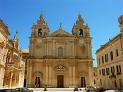
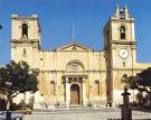
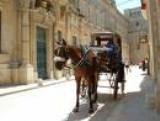
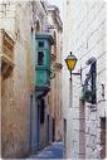
Most of Mdina's palaces serve as private homes. The impressive Cathedral of the Conversion of St Paul is fronted by a large square. Only a limited number of resident and emergency vehicles, wedding cars and hearses are allowed within Mdina.
|
|
|
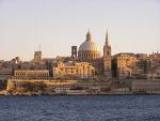
The foundation stone of Valletta was laid by the Grandmaster of the Order of Saint John, Jean Parisot de la Valette on 28 March 1566. The Order decided to found a new city on the Xiberras peninsula just after the end of the Siege of Malta in 1565, so as to fortify the Order's position in Malta and bind the Knights to the island. The city was designed by Francesco Laparelli. Many of the most important buildings were built by the Maltese architect Gerolamo Cassar. Valletta is an urban area which boasts many buildings from the 16th century and onwards, many built during the rule of the Knights of St. John of Jerusalem (the Knights Hospitaller).
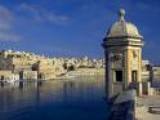
La Valette placed the first stone in Our Lady of Victories Church. The city's plan was a departure from medieval Maltese architecture, which exhibited irregular winding streets and alleys. Laparelli designed the new city with rectangular grids, without any collacchio (an area restricted for important buildings). The streets were designed to be wide and straight, beginning centrally from the City Gate to end at Fort Saint Elmo overlooking the Mediterranean. Certain bastions were built 153 feet (47 m) tall.
|
|
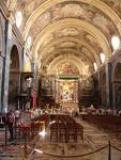
La Valette died on 21 August 1568, aged 74 and never saw the completion of his city. Originally interred in the church of Our Lady of the Victories, his remains now rest in St. John's Co-Cathedral. His tomb is surrounded by those of other Grand Masters of the Knights of Malta.
After the Knights' departure and the brief French occupation, building projects in Valletta resumed under British rule. They widened gates, demolished and rebuilt structures, widened newer houses over the years, and installed civic projects.
Nazi and Fascist air raids throughout World War II destroyed areas of the city and its infrastructure. The majestic Royal Opera House, constructed at the city entrance in the 19th century, was one of those lost in the raids. |
|
|
|
|
Tour B - Valletta the capital City - Għar Dalam- Hagar Qim - Marsaxlokk The Fishing Village - Mdina the silent City |
| |
|
The foundation stone of Valletta was laid by the Grandmaster of the Order of Saint John, Jean Parisot de la Valette on 28 March 1566. The Order decided to found a new city on the Xiberras peninsula just after the end of the Siege of Malta in 1565, so as to fortify the Order's position in Malta and bind the Knights to the island. The city was designed by Francesco Laparelli. Many of the most important buildings were built by the Maltese architect Gerolamo Cassar. Valletta is an urban area which boasts many buildings from the 16th century and onwards, many built during the rule of the Knights of St. John of Jerusalem (the Knights Hospitaller).
La Valette placed the first stone in Our Lady of Victories Church. The city's plan was a departure from medieval Maltese architecture, which exhibited irregular winding streets and alleys. Laparelli designed the new city with rectangular grids, without any collacchio (an area restricted for important buildings). The streets were designed to be wide and straight, beginning centrally from the City Gate to end at Fort Saint Elmo overlooking the Mediterranean. Certain bastions were built 153 feet (47 m) tall.
|
|
La Valette died on 21 August 1568, aged 74 and never saw the completion of his city. Originally interred in the church of Our Lady of the Victories, his remains now rest in St. John's Co-Cathedral. His tomb is surrounded by those of other Grand Masters of the Knights of Malta.
After the Knights' departure and the brief French occupation, building projects in Valletta resumed under British rule. They widened gates, demolished and rebuilt structures, widened newer houses over the years, and installed civic projects.
Nazi and Fascist air raids throughout World War II destroyed areas of the city and its infrastructure. The majestic Royal Opera House, constructed at the city entrance in the 19th century, was one of those lost in the raids.
|
|
|
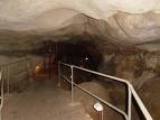
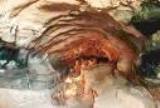
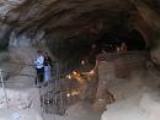
Għar Dalam (pronounced ar dàlam in Maltese and meaning "Cave of Darkness") is an extraordinary prehistorical cul de sac containing the bone remains of animals that were stranded and subsequently became extinct on Malta at the end of the Ice age. It has lent its name to the Għar Dalam phase in Maltese prehistory.
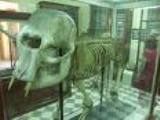
Dwarf elephant, hippopotamus, deer and bear bone deposits found there are of a different age; the hippopotamuses became extinct about 180,000 years ago, whilst the deer species became extinct much later, about 18,000 years ago. It is also here that the earliest evidence of human settlement on Malta, some 7,400 years ago, was discovered.
The cave was first scientifically investigated in 1885, but was not opened until 1933, and also was used as an air-raid shelter during World War II. A museum was set up on site by the then curator of Natural History Dr J.G. Baldacchino. In 1980, the most important and irreplaceble relics—such as four tusks of dwarf elephants and the skull of a Neolithic child—were unfortunately stolen from the museum there.
|
|
The cave was investigated in 1987 under the direction of Emanual Anati, Professor of Paleoethnology at Leece University. His team of Italian archaeologists from Centro Camuno di Studi Preistorici discovered Palaeolithic cave art depicting human hands, anthropozoomorphic, and several animal designs from underneath the stalagmatic formations. Some depicting elephants which have been extinct in the Maltese region since the Pleistocene. Most of these finds were destroyed due to recent vandalism.
The cave is some 144 metres deep, but only the first fifty metres are open to visitors. The museum, which still exhibits a remarkable wealth of finds from animal bones to human artifacts, is the entrance to the whole area.
|
|
|
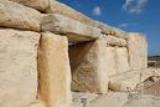
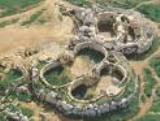
Ħaġar Qim (IPA: [hæʤər'ʔi:m]) (English: Standing/Worshiping Stones) is a megalithic temple complex found on the Mediterranean island of Malta, dating from the Ġgantija phase (3600-3200 BCE). The Megalithic Temples of Malta are amongst the most ancient religious sites on Earth, described by the World Heritage Sites committee as "unique architectural masterpieces." In 1992 UNESCO recognized Ħaġar Qim and four other Maltese megalithic structures as World Heritage Sites. Vere Gordon Childe, Professor of Prehistoric European Archeology and director of the Institute of Archaeology in the University of London from 1946-1957[5] visited Ħaġar Qim. His observation was:
|
I have been visiting the prehistoric ruins all round the Mediterranean, from Mesopotamia to Egypt, Greece and Switzerland, but I have nowhere seen a place as old as this one. |
|
Ħaġar Qim's builders used globigerina limestone in the temple's construction. As a result of this the temple has suffered from severe weathering and surface flaking over the millennia.
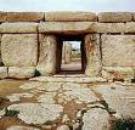
The temple’s façade is characterized by a trilithon entrance, outer bench and orthostats. It has a wide forecourt with a retaining wall and a passage runs through the middle of the building, following a modified Maltese megalithic design.A separate entrance gives access to four independent enclosures which replace the north-westerly apse.
|
|
|
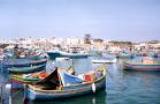
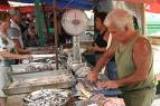
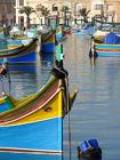
Marsaxlokk is the foremost fishing village and, perhaps, the most picturesque seaside locality in Malta. Fishing nets are often spread on the quay to dry in the sun and, quite often, sturdy fishermen can be seen mending these nets. These activities, together with the modest houses by the quayside, lend the place charm and serenity.
Most of Malta's fish supplies are caught by fishermen coming from this port. Swordfish, tuna, and the popular 'lampuki' are caught in abundance between spring and late autumn. On weekdays, the catch is taken to the fish-market in Valletta, but on Sundays fish is retailed by fishermen in the open on the quay.
Fish restaurants have opened to meet the ever-increasing demand. The tourist influx to Marsaxlokk has also attracted many hawkers and souvenir vendors.
|
|
The contemporary population of Marsaxlokk is around 4,000. In the past, a great percentage of the population worked as full-time fishermen. The number of working fishermen has decreased, in part because people from other localities have moved to the village.
|
|
|
Mdina was inhabited and possibly first fortified by the Phoenicians around 700 BCE. The Phoenicians called it Maleth.[2] The region benefits from its strategic location on one of the island's highest points and at maximum distance from the sea. Under the Roman Empire Malta became a Municipium and the Roman Governor built his palace in Mdina. Tradition holds that the Apostle St. Paul resided in the city after his historical shipwreck on the islands. Much of its present architecture reflects the Fatimid Period which began in 999 AD until the Norman conquest of Malta in 1091 AD. The Normans surrounded the city with thick defensive fortifications and widened the moat. The city was also separated it from its nearest town, Rabat.
Malta passed to the Order of Knights of the Hospital of St John of Jerusalem in 1530 AD. Mdina hosted the public ceremony in which each Grand Master swore an oath to protect the Maltese Islands and the rights of his subjects. A strong earthquake in 1693 AD led to the introduction of Baroque design within the cityscape. The Knights of Malta rebuilt the cathedral, to the designs of Maltese architect Lorenzo Gafa. Palazzo Falzon, the Magisterial Palace and major restoration works are other projects undertaken by the Knights.
|
|
Present
Most of Mdina's palaces serve as private homes. The impressive Cathedral of the Conversion of St Paul is fronted by a large square. Only a limited number of resident and emergency vehicles, wedding cars and hearses are allowed within Mdina.
|
| |